In Conversation with Julissa Bruno
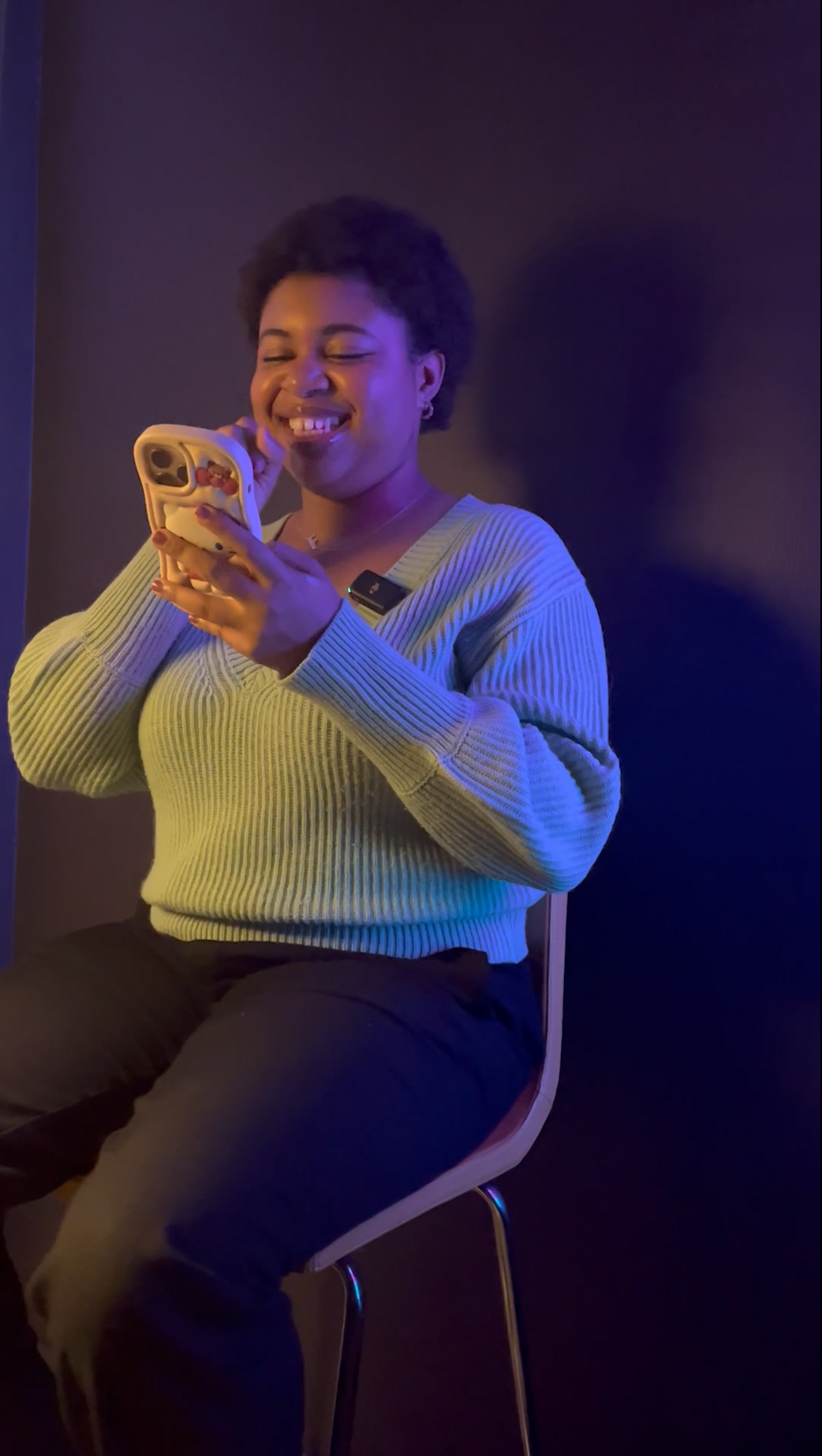
Julissa in the meditation room at the studio
Introduce yourself!
My name is Julissa Bruno. I'm an artist based in Cleveland. I'm originally from Queens, New York. I make mixed media drawings on paper. And I'm the 10th feverdream resident.
So how would you say your overall experience at feverdream was?
Well, it was new for me. Creating work in a different space coming out of art school. So it felt much more casual, much more lighthearted. And it was also nice to have somebody to bounce ideas off of while I was up there. I felt like I had a lot of time to myself and to think. I felt like there was coziness. There was privacy. So. Yeah, I really enjoyed it.
What would you say during your time here that you learned about your practice?
I learned how to self motivate. That was honestly the biggest challenge for the three months that I was here at feverdream. I had to make my own schedule. I had to push myself to create work. And my solution for that was just coming into the studio as much as possible. And it truly was a challenge to sit there and figure out how to structure things without any instruction. But I learned a lot about how I get things done and how I can come up with ideas. How I work in the studio in terms of organization. So I learned a lot about myself and how I can push myself forward, outside of that academic space.
Did you see this as a boost for you as an emerging artist? In what ways did it set you ahead?
Well, other than the connections that I have formed from it, I think that time in the studio is what really set me ahead and learning how I can work by myself, what kind of work I want to create. And also the crits were really helpful in terms of how serious or unserious things need to be. That was a big one for me because in school critique is a really serious thing. And it made me realize that I can make the work that I want to make and I don't have to worry about historical context or–I think I'm kind of like getting out of it– [trails off].
I think the most successful thing was keeping me in my practice. You know, because a lot of us fear out of graduation that we're 1. not going to find a career in the arts or 1. we're just going to fall out of habit and never make art again. So that keeping me in my practice is what gave me the motivation to know that I can be an artist outside of school. And also, of course, it helped me push my music as well, because the stipend helped me in getting better music equipment. So now I'm not only pushed forward in my visual art but I also have more motivation and more of the tools I need to make music as well.
Did you find yourself experimenting in the studio? What did you experiment with?
Yeah.The experience just made me want to try new forms of drawing. I think in school, they get us into the habit of making a body of work and something that's more in a similar vein, but I think I really enjoyed just experimenting throughout the entire process. Especially, trying to push myself to make more abstract work because I make really figurative stuff usually. Like in school, I did. So it was interesting to push myself to make something abstract in a way that I've never, ever made it before. Just trying to figure that out and having the time and space to figure that out I think, was really helpful.
How would you say you surprised yourself during your time here?
I think definitely in the type of work I made, I came in with no expectations for myself, in terms of what the art was going to look like. And that's always been my favorite part of making art. Period. Just coming in with intuition and making decisions on the spot or making decisions abstractly. I was making music, listening to music. I'm trying to translate the sound visual. And that is not ever going to be a direct translation. But it was fun to see my own interpretations of that. So I surprised myself [by] just making work that doesn't look like anything I feel like I've ever made before. And that way I've pushed my skills as well. I feel like I can incorporate so many new things into my work.
What would you say is your favorite piece that you've made here and why?
I think my favorite piece and song that goes with it is Stuck in This Middle. It's the piece with a swirling hurricane/ocean with the two kites flying over. I just think it's so ethereal and dreamy. And I think it matches the song perfectly. Which is, you know, something throughout this whole project. I was trying to make the visual connect to the audio as much as possible. And I think in that one it was the most successful. And, I just love how whimsical it is. That one was the combination, the strongest song, strongest visual.
I think they speak to each other directly. They are each other. And I also that's one of the songs where I incorporated soundscapes or I had ocean sounds in that one. So it's like there is no way you cannot make a direct correlation from that drawing that, that song when there's water happening and the birds and I'm just so happy with the full image that I've created with that one at least for myself.
Is there a parallel to translating between two languages, English and Spanish, and two mediums, drawing and music?
Yeah. I think in difference to other moments of my practice where I have used music as inspiration. The biggest difference here is that I'm making it. So I would typically start by making a song in a vacuum–not really thinking too much about the artwork. But I would leave it open. I would kind of leave the song maybe 50 or 80% done. Then I would start drawing, based off of maybe what symbols the sounds are making me think of or what the lyrics were making me think of or sometimes it would be direct sound. It was like I drew a cicada because I used these buzzing sounds. It would be things like that. But typically I would go back and forth for most of it.
especially for that ocean one as well. I started the song and then I was thinking of this composition, and then I was like well, I should add some ocean sound in here. So it's like, I found that it's easier for the pieces and the music to be more interconnected. If I do that back and forth motion on each one because then I felt like they would be a little bit too separate, at least for me, because people are going to interpret it however they want to interpret it. But it was important to me that they felt directly linked.
What was your biggest takeaway of the residency?
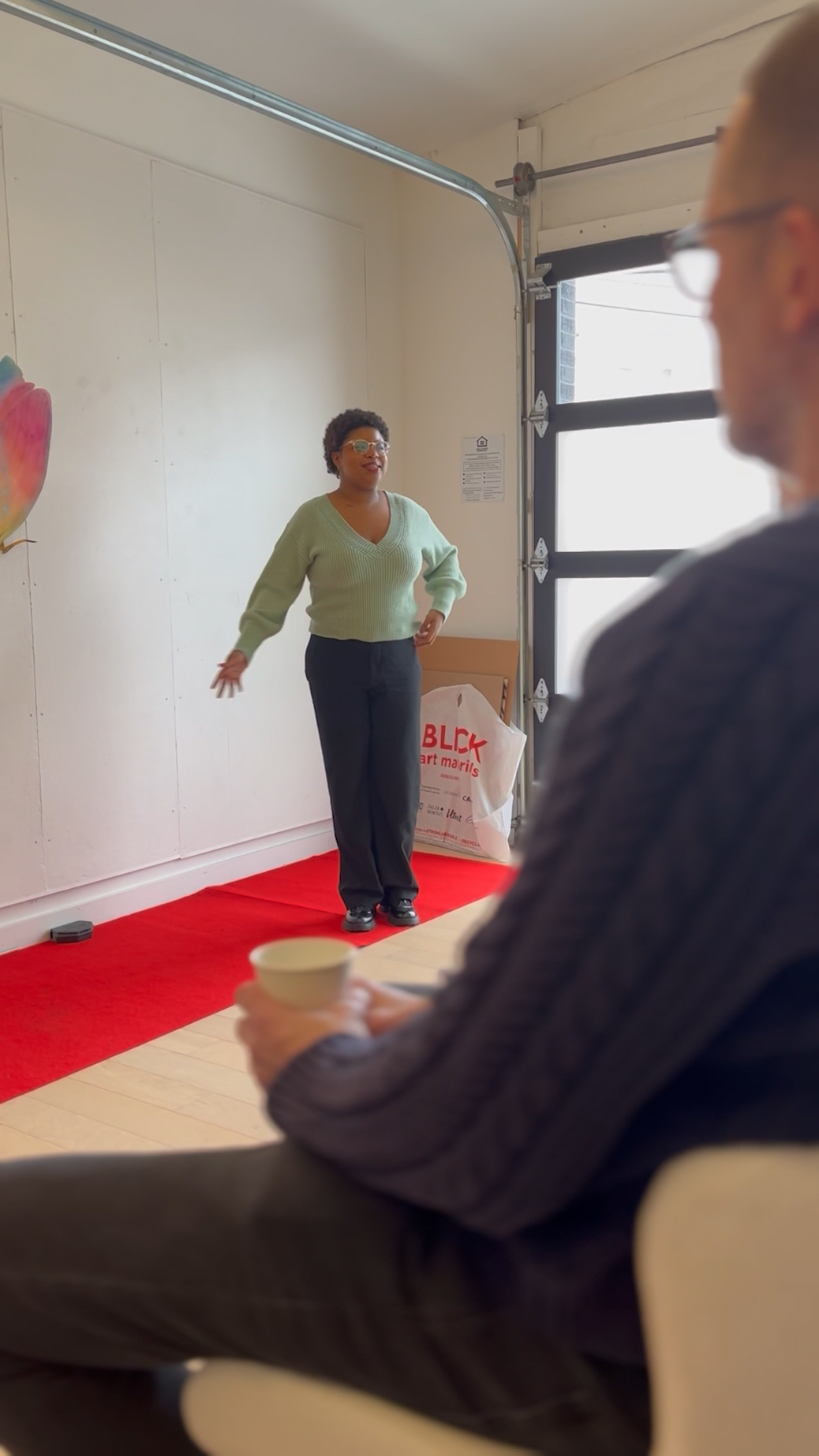
Final Crit
I think in producing work for myself, I know I'm a little repetitive with that one, but that's like, that's genuinely what I've gotten out of it. I didn't know how I was going to do this outside of school. I'm like, how am I… there's no teacher breathing down my neck to be like, you got to finish this in time. And then of course with the music, I had so much time to develop my skills in music that I was able to move on from GarageBand–which is a free version of, yeah, a very amateur program of making music–to Logic. Which is used by a lot of musical professionals in this day and age.
So it was really nice. Also showing my music to other people during the crit and they're like, oh no, you're ready to move on. Like Nolan is the other one. He was like just get a better program, you're ready to go. So I think, I think, you know, producing work for myself and not thinking too hard about meaning and context and just making the work that I want to make. Making, freely experimenting and sharing with others, openly and all the time, I think, is what I got out of this experience.
What would you say you're most nervous about coming here?
I think that was what I was most nervous about. Being the only person who draws. And also I'm not working on square canvas. I didn't know how that was going to be received. Because you know, in school, they were pushing me to experiment in that way when I was cutting up the paper.To me, that was the bravest thing I've ever done and to put it in front of all my peers was nothing. Because I'm like, these people know me. These people accept me. So I was scared that I wouldn't come off as professional enough or my work wouldn't come off as professional enough, to be shown to be respected and to be talked about.
What did you think of the critiques?
Yeah, I think pretty much along the lines of what I had said in the why critique is important clip. For me, the best thing is talking to another artist and connecting mind to mind. It's not everybody has the opportunity to talk to other artists as an artist. Not everyone has that resource. So to me it's nice to be like, oh, well, what do you do when this happens? Or how do you come up with ideas? How do you get out of this sort of mindset? And also just the plethora of references and it's always so helpful to not feel like you're alone and making your work and like you're not crazy or with your ideas. And to hear that from another person who makes. Because they can also tell you about your craft, or is this getting across? Because you can ask anyone, I'll ask my parents, I'll be like, what do you think of this? And they'll be like, why is it green? or something, you know what I mean? It's not as valuable. Unless you're hearing it from another artist because they're more in tune with communicating visually. And then it was also nice to be critiqued by people who also have experience in music, like Nolan. Because I'm a fan of his music. I've listened to his music before. So it was cool to hear what he had to say in terms of my melodies, my vibe and who it's reminding him of how I can improve my production. So, yeah, just in that same vein of hearing it from somebody who knows what they're talking about is really validating.
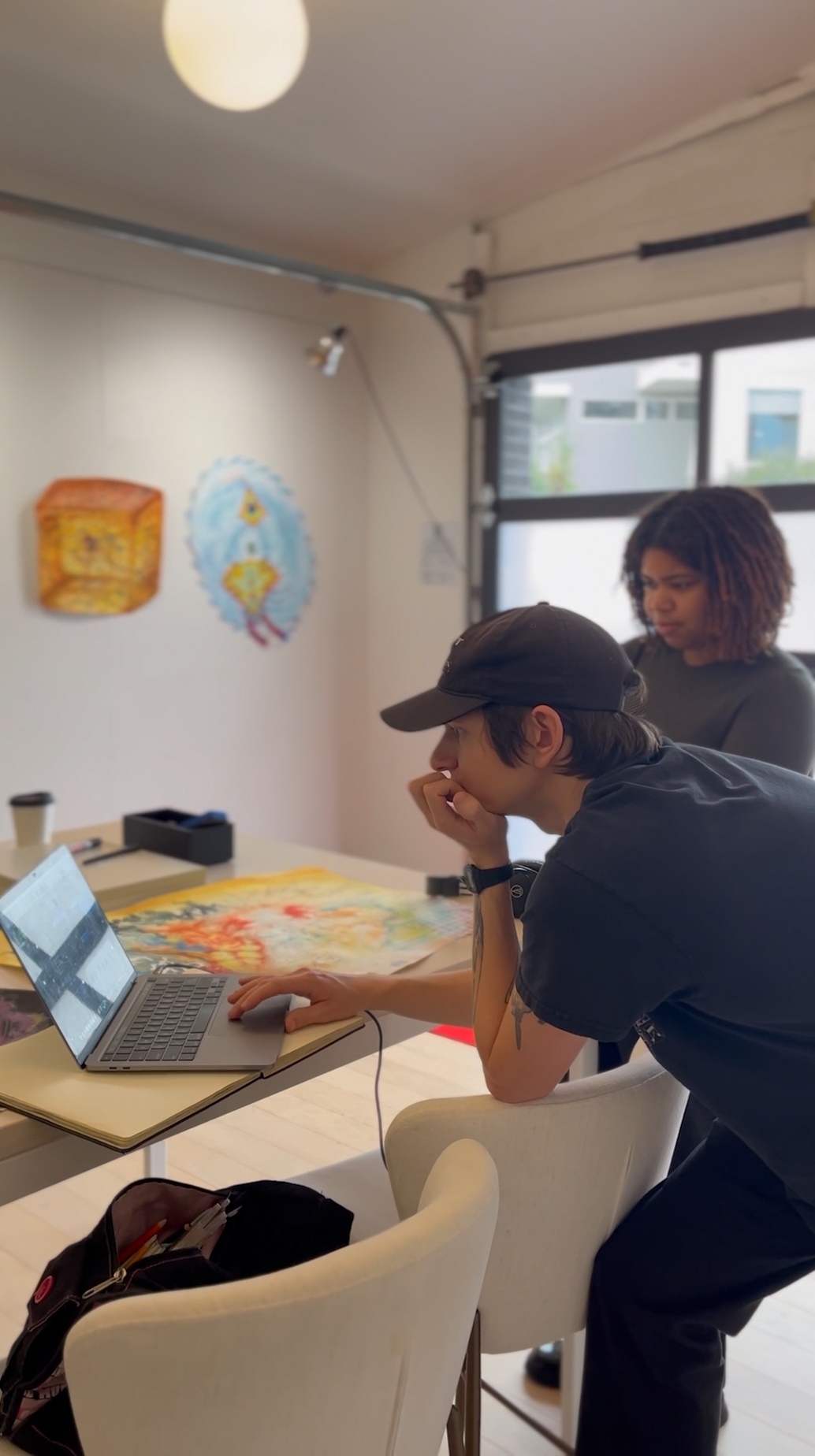
Critique with Nolan Meyer, the first feverdream resident
What’s something that stuck with you from one of the critiques?
I'm going to say again, Nolan telling me to move on from GarageBand. He said it kind of puts a ceiling on how far you can get, you know?
Who’s your favorite artist?
My favorite artist is Firelei Baez. She's a Dominican American artist and she makes work about colonization. I just love her work because, you know, I connect with it personally as a Dominican person. Her work is about colonization in the Caribbean. And then I'm just really inspired by her mark making as well. She uses a lot of pinks, a lot of splashes, a lot of glitter and feather and different shiny textures. So, yeah, I just love her stuff.
What would you say consistently drew inspiration from during residency?
I think more along the music lines. I listen to a lot of music that sounds like it was made in someone's bedroom. Or it was made by one person. One person that I think of a lot, that my songs kind of sound pretty similar, too. Like Clara La San. She makes these very ethereal, floaty songs, and her voice is pitched up a little bit. And I always pitch up my songs because she pitches up her songs. It just makes it sound like it's an inner monologue or it adds a layer of emotion to it. So I think, you know, from listening to a lot of artists like her, you know, like Frank Ocean as well.
I took inspiration from that. And in terms of the artwork and coming up with ideas and symbolism, I just took inspiration from my daily life because I was making work that was really intuitive, really based on emotions of the moment. The piece that I had made called System was about limerance and it was about this deadly crush that I had at the time, and I had made the song about the deadly crush. And then I was doing research on limerance and that's where I got the idea to draw something that looks like a nervous system. So it's I'm just taking parts from my daily life how I'm feeling. You know, especially being in a transitionary period of my life where I just finished college and now I have to make my way in the world.
What’s your advice on applying to programs such as this?
You know, I think this is a little corny, but it's being yourself and setting your foot forward with your idea that you think might not work or is a little bit stupid. When I applied with the idea to make music and make art and make them both at the same time, I was like, there is no way they're going to be–they're just going to think I'm just sitting there fiddling on my computer or whatever or they're going to ask for my credentials. Because when I applied, I was like, well, this will be an experiment. This will be something that I haven't really done before, like all the way. So I think if you talk about things like you have an idea of what might happen. But still be open to experimentation and be honest with saying well, I just want to try this out. I think they'll take you on. You don't have to impress anybody. Just go for the ideas that you're actually interested in for yourself. I want to see what happens if I do this, you know, I think it’s much better than, I don't know, trying to come off as some kind of ultra professional who's never messed up once.
What are you looking forward to most in your career?
Well, I'm looking forward to making more work. I'm looking forward to making more music. Now that I have access to a better music program. And I'm looking forward to using this process again to produce more work now that I know. Now that I've worked out all the kinks of it because the whole time I was here, I'm figuring out how can I do this? How can I do this? How many different ways can I do this? Now that I know that I can produce so many different images with this same process and end up with not only an artwork but also a song. So I'm excited to do it again. I'm excited to do it 100 times. I'm excited to show it to everybody.
Was there a new technique you learned while here and how did it change your practice?
I think I learned a lot of patience when working abstractly. Because typically I will draw a lot of faces, I'm a portrait type of person. And that's something that I can hash out real quick. When you're looking at a reference, you're kind of just like, okay, some a lot of it is busy work until you decide to take liberties. So I think I really learned to take my time. I've never sat down and drawn the same thing for like a week and a half. So I'm thinking specifically of my piece with all the veins that kind of looks like a nervous system. Drawing all those little lines and taking my time and seeing where they go.
And also my dome-like piece respraying the background and adding new marks very slowly. So I think I've learned to step back, keep looking for longer and think about where it could go. Specifically in abstraction because I don't really work that way at all. So now I know that I can. And it felt like a meditation, it was really relaxing just to slow down in that way. I think, that's probably the new technique that I've learned here.
What would you say your favorite thing about making art is in general?
My favorite thing about making art is experimentation and intuition. I love to just throw the paper down and get started. I'm not really a fan of sketching things out or hyper planning things. I feel like the work is more authentic when it's a burst of what you're feeling in the moment. So that's my favorite part. And of course intuition with materials as well, because I will never make something that I'm only using a singular medium for. I think it's way more intuitive. And there's so much more freedom when you have a bunch of materials in front of you and they're all mixed up and you're figuring out how to make certain colors work out in certain textures, see how they mix on top of each other. So the material and medium are definitely also my favorite part. That was like four favorite parts.
As mixed media and supply royalty, what is your favorite tool in the studio?
That is a hard question. I'm going to say paper. I'm going to say paper. I only work on paper. It's my favorite surface to put the work on. And I recently got into cutting the paper into shapes. And then now maybe I'll take a certain little part and I'll bend it so it stands off of the wall. So I'm slowly taking more and more control over what the paper is doing once I hang it up. But I'm always going to be working on paper and I'm learning to push it as well. So I'm going to say that's my favorite.
How does it feel to think about the grammar of your native language while here because someone else at the studio was learning it and would ask you questions?
I don't know how to answer that other than It's just really fun. I think I've felt much more comfortable in the studio when we have those moments when we're trying to communicate to each other in Spanish and you'll ask me like, do you say this or do you say this because I know you specifically are learning a more Puerto Rican Spanish. [I speak] more Dominican spends. And it's always fun to me. I do that with my friends as well who are from other Latino countries where we're just comparing, contrasting. And I love teaching people anything about my language, about my culture. So you being curious and also being open and us having also those chisme secret conversations in Spanish gave me a lot of comfort in the studio, honestly. And I'm really grateful for those moments. I don't in terms of thinking about the structure of the language, I don't I still don't know how to answer that. It's like how you told me you would say oh, the, the conjugation or whatever. And I'm like, well, I don't know. I just, I just speak it like, you know. It's just something that I do. So I don't really think about it in that way. It's such an academic way of thinking about it. But if I learned French or something, I would probably have to think of things in that way.
Who was your number one listened to artist this year?
[Let’s see…] Who had me in a chokehold this year? Probably Janae Aiko. I think it’s Janae Aiko, let’s find out.
It’s Frank Ocean.